MARA-Med joins Sirene Festival in Palermo
Sexual and reproductive health and rights are vital, and they are worth celebrating! As MARA-Med, we are proud to join Maghweb at Sirene Festival in Palermo, Italy along with ALEG, Schedia Stin Poli and Associació dels drets sexuals i reproductius within the framework of IRIS project.
The Sirene Festival, had its third edition this year, and once again aimed to strengthen the role of young people and raise awareness of sexual health and sexual and reproductive health and rights (SRHR). The main objective was to enhance participants’ agency by providing tools to support the development of their skills as conscious, active and informed citizens. The festival’s main target was twofold: on the one hand, young people, who were encouraged to take on an active role; and on the other, civil society organisations and local groups, with the aim of strengthening support and mutual aid networks. The event officially opened with the internal partners’ meeting, a space dedicated to coordination and to defining monitoring strategies among the partners.
The event took place over three days and offered a range of activities. The festival included three main panel discussions, structured as open-mic talks to facilitate direct and horizontal dialogue between health professionals, international experts and young people. The latter actively asked professionals questions about institutional barriers, conscientious objection and obstetric violence, transforming scientific and political information into shared knowledge. Through the sharing of real-life cases and networking tools, the festival acted as an incubator for young activists and professionals, helping them improve their strategies to support reproductive autonomy.
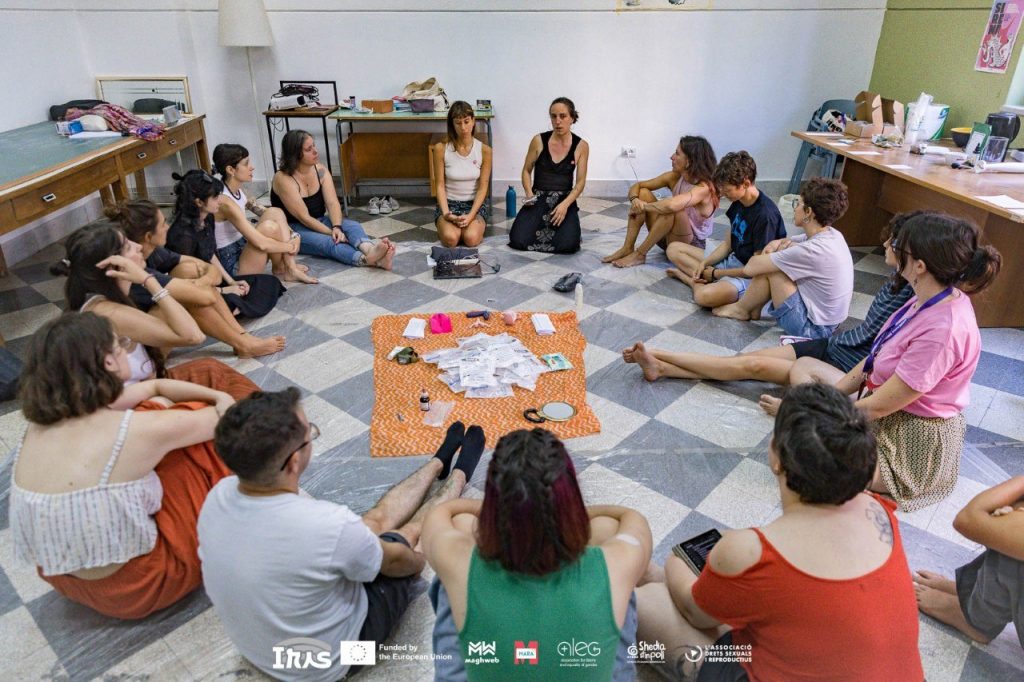
The workshops, by contrast, focused on the acquisition of practical skills related to various topics, such as one’s own body and sexual health, as well as the collective imagination of new inclusive languages and words. In particular, in the workshops dedicated to scientific appropriation and health, such as Biohack Lab and Guarda un po’!, beneficiaries acquired technical and science-based skills relating to the use of the most common gynaecological instruments, self-monitoring and how to detect an infection at an early stage.
Furthermore, the workshop dedicated to sexuality and disability, Abitare un corpo che non rientra, enabled young people and organisations to map practical tools aimed at reclaiming the sexual and reproductive rights of marginalised bodies. Another topic explored through the workshops was language and self-expression, offering young people the opportunity to take a direct and active part in creating something. In the Punchline workshop, focused on transfeminist rap, participants acquired writing techniques and rhythmic metre, using them to translate systemic issues and social barriers into political verses, followed by a collective jam session.
The live events and theatrical performances, such as Tekken Drama and Travesia y Conjuro, used art as an innovative tool to engage both young people and the general public. By bringing highly sensitive topics such as emotional dependency and violence in relationships to the stage, the performances addressed social taboos, transforming them into moments of public debate and reflection.
Disclaimer:
Funded by the European Union. Views and opinions expressed are however those of the author(s) only and do not necessarily reflect those of the European Union or the European Education and Culture Executive Agency (EACEA). Neither the European Union nor EACEA can be held responsible for them.
 Arabic
  English